
If you are looking at homes in Oakland County, South Lyon stands out immediately. It has a distinct character that feels different from the standard suburban sprawl. While it is certainly a modern community with great amenities, its charm comes from a very real, preserved history.
This isn’t just a commuter town that popped up overnight. South Lyon started as a rugged farming settlement and grew into a booming railroad hub. The city has survived fires, moved entire buildings to save them, and maintained a strong sense of identity since 1832. Whether you are already living in South Lyon or just visiting, understanding the backstory makes walking down Lake Street feel a little more special.
Let’s take a look at how “Thompson’s Corners” evolved into the South Lyon we know today.
Early Settlement: From Thompson’s Corners to South Lyon
Long before we had paved roads and subdivisions, this area was a dense forest waiting for pioneers. The story really begins in 1832. That year, a widow named Mrs. Thompson and her son, William, purchased land and established a homestead. For quite a while, the area was simply known as “Thompson’s Corners.”
It wasn’t a city yet, but rather a small collection of farms and a general store that served the locals. As more settlers arrived, the need for a formal identity grew. In 1847, the first post office was established, marking a major step toward becoming a recognized village.
You might wonder where the name “Lyon” actually came from. It wasn’t a local family, but rather a tribute to Lucius Lyon, a member of the the state legislature. The surrounding area was named Lyon Township in his honor. Because the village was located in the southern part of that township, the name South Lyon stuck, distinguishing the community geographically from the rest of the rural township.
The Railroad Boom: Becoming a Transportation Hub
If you look at a map of South Lyon, you can still see the influence of the tracks. While the early days were defined by agriculture, the arrival of the railroad changed everything. The pivotal moment came in 1871 with the arrival of the Detroit, Lansing and Northern Railroad.
Suddenly, farmers didn’t have to rely on slow wagons to get their grain and produce to larger markets. The village exploded into a commercial center. At its peak, South Lyon was an intersection for three different rail lines: the Pere Marquette, the Grand Trunk Western, and the Ann Arbor Railroad.
This access turned the small village into a genuine hub. Hotels sprang up to accommodate travelers, grain elevators were built to handle the harvest, and the population began to climb. The railroad didn’t just pass through; it was the lifeblood of the local economy for decades.
The Legend of the Witch’s Hat Depot
You can’t talk about South Lyon history without mentioning its most famous silhouette. If you have looked at things to do in South Lyon, you have almost certainly seen photos of the “Witch’s Hat.”
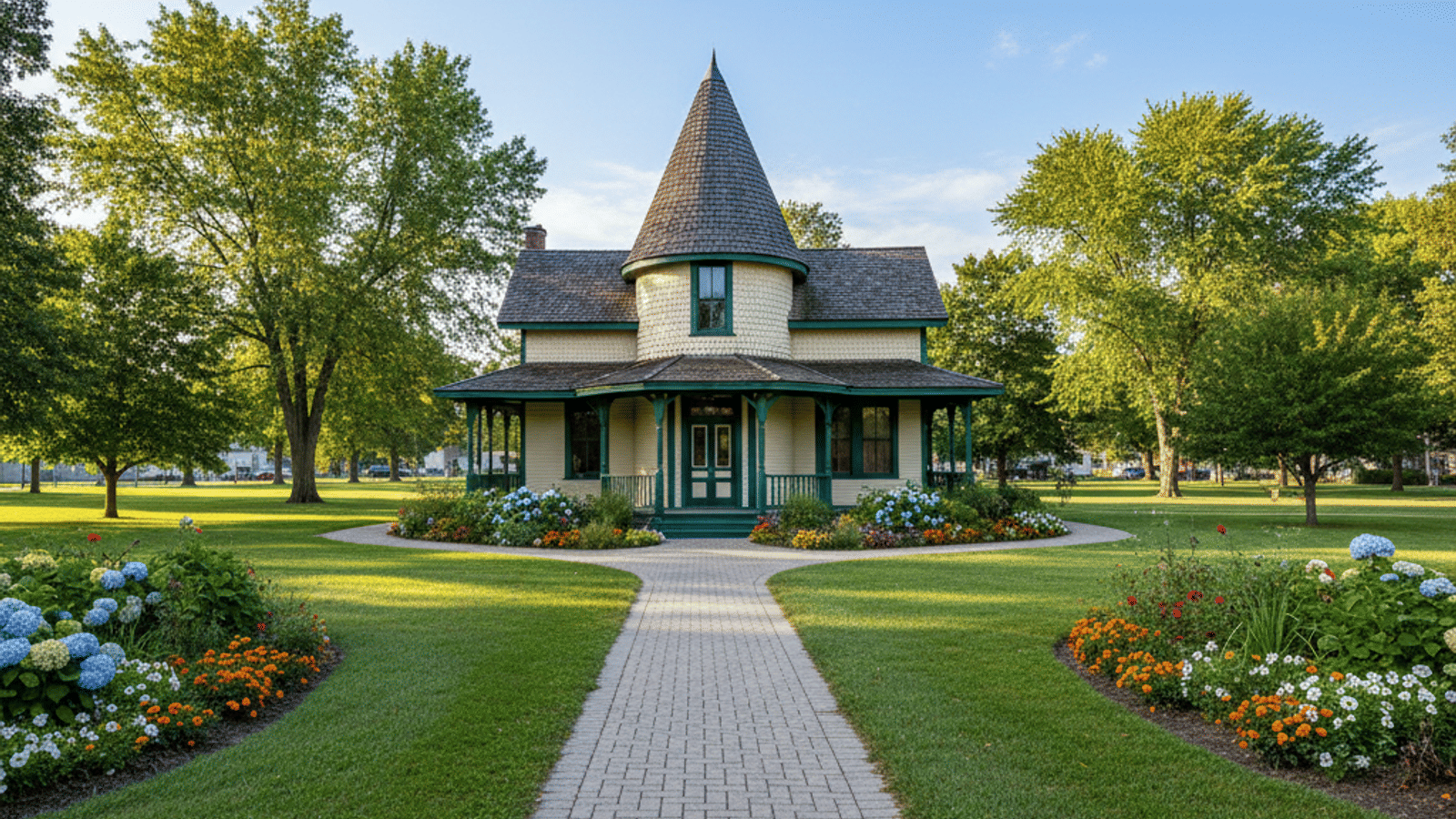
The original depot burned down in the early 1900s—a common hazard in the era of steam engines and wood buildings. It was rebuilt around 1909 in the Queen Anne architectural style. The defining feature, of course, is the large conical roof on the operator’s tower, which looks exactly like a traditional witch’s hat.
It is a rare piece of architecture that the community fought hard to save. By the 1970s, the depot was at risk of being demolished. In a massive community effort in 1976, the building was lifted and moved from its original location near the tracks to McHattie Park to ensure its preservation.
Today, it stands as the centerpiece of the South Lyon Area Historical Society’s Historic Village. It operates as a museum where you can see exactly what travel looked like a century ago. The village setting in the park also includes the Freight House, the washburn School, and a vintage caboose, creating a walkable timeline of the city’s past.
Historic Landmarks & The Downtown District
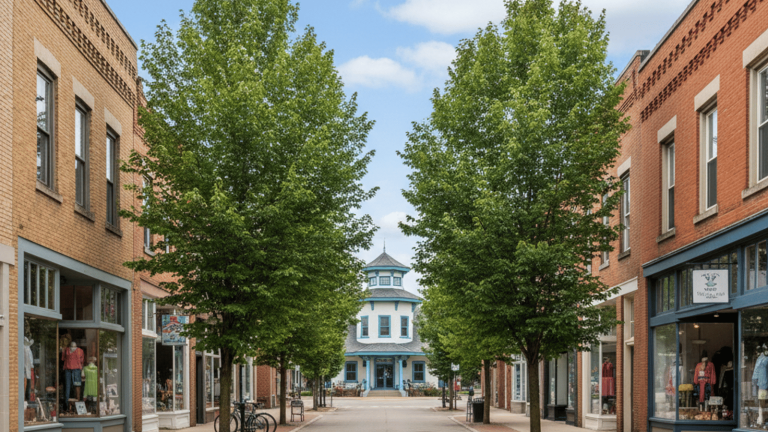
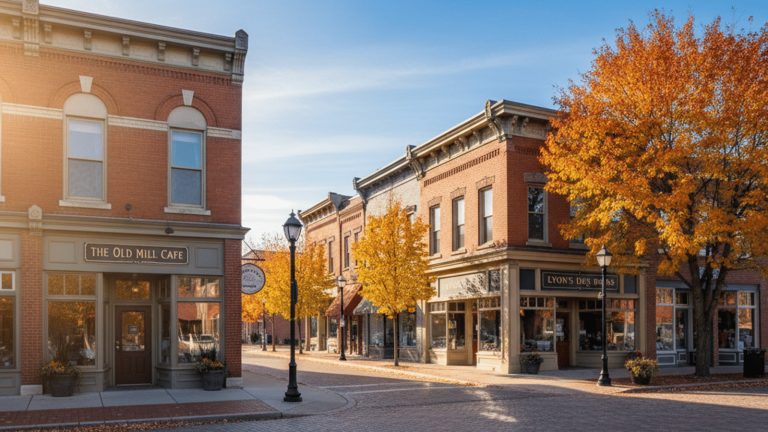
Beyond the depot, the downtown area—specifically along Lake Street and Lafayette Street—has been the commercial heart of the town for over 150 years. The transition from dirt roads with horse-drawn carriages to a modern, walkable downtown has been gradual, but the historic footprint remains.
One of the most fascinating buildings is the South Lyon Hotel. It was originally built in 1867 and has served as a gathering place for generations. The history here is a bit spooky; local lore states the hotel was built on the site of an old cemetery. While most of the graves were relocated to the current cemetery (allegedly for about $2.50 per body), rumors persist that not everyone was moved, fueling local ghost stories for decades.
The hotel is also a testament to the city’s resilience. In 2016, a devastating fire nearly destroyed the historic structure. In true South Lyon fashion, the community rallied around the landmark. It was rebuilt and reopened in 2017, carefully designed to retain its 19th-century charm while meeting modern safety codes.
From Village to City: 20th Century Growth
The political structure of the town evolved right alongside its population. South Lyon was officially incorporated as a village in 1873, shortly after the trains arrived. However, it didn’t incorporate as a city until 1930.
Throughout the mid-20th century, the economy began to shift. While agriculture remained vital, light industry began to move in. After World War II, the rise of the automobile and the interstate highway system made it possible for residents to live in South Lyon and commute to jobs in Detroit or Ann Arbor.
Despite this modernization, the area held onto its rural roots for a long time. For many years, South Lyon was informally known as a “Horse Capital” due to the high density of equestrian farms and riding stables in the surrounding countryside. You can still see this influence today in the layout of the wider area, even as new subdivisions have been developed.
Celebrating History Today
South Lyon isn’t a city that keeps its history locked behind glass; it celebrates it actively. If you are considering moving to South Lyon, you will likely attend Pumpkinfest. This massive annual event held every autumn is a direct nod to the area’s agricultural harvest traditions.
Another key event is Depot Day, which specifically honors the railroad heritage that put the town on the map. The South Lyon Area Historical Society works tirelessly to maintain the archives and the Historic Village, ensuring that as the city grows, the context of “where we came from” isn’t lost.
New developments in the downtown area are often reviewed with an eye toward preserving the historic aesthetic. It is a balancing act between offering modern conveniences and maintaining the small-town feel that has drawn people here since the days of Thompson’s Corners.
Frequently Asked Questions About South Lyon History
When was South Lyon, Michigan founded?
South Lyon was first settled in 1832 by the Thompson family. However, it wasn’t incorporated as a village until 1873 and didn’t officially become a city until 1930.
Why is the train station called the Witch’s Hat?
The nickname comes from the depot’s distinct Queen Anne architecture, specifically the steep, conical roof on the turret. The shape bears a striking resemblance to a traditional witch’s hat, making it a unique landmark in the state.
Is the South Lyon Hotel really haunted?
Local legends suggest it might be, largely because the hotel was built in 1867 on top of the village’s first cemetery. While records show bodies were moved to the new cemetery for $2.50 each, stories persist that some graves may have been left behind.
What is the difference between South Lyon and Lyon Township?
They are two separate municipalities with their own governing bodies and tax structures. The City of South Lyon is a smaller, more improved urban center, while Lyon Township surrounds the city and covers a much larger, historically rural area.